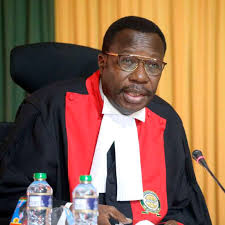
Justice Smokin Wanjala…Photo/courtesy.
By Peter Mwibanda
NAIROBI — Kenya’s political chessboard is shifting as two Supreme Court judges near retirement.
The retirements are creating vacancies that could influence the legal and political fate of the 2027 general election.
The looming exits have set off quiet but intense maneuvering within President William Ruto’s Kenya Kwanza administration, which is already mapping its strategy for a second term amid mounting public discontent.
These retirements triggered by the constitutional age limit of 70 are far from routine.
They present a rare chance to tilt the ideological balance of the nation’s highest court, the final arbiter of presidential election disputes.
The stakes: whether political expediency will outweigh judicial independence.
Who’s Leaving and Why It Matters
Chief Justice Martha Koome will still be on the bench in 2027 but Justices Mohammed Ibrahim and Smokin Wanjala are due to retire within the next two years.
Both have been central in major election rulings including the 2017 annulment of Uhuru Kenyatta’s win and the 2022 validation of Ruto’s presidency.
Replacing them offers the president a powerful opening.
In 2022 the court upheld Ruto’s win by a narrow 4–3 margin.
Even one new politically aligned justice could shift the outcome of a future petition potentially deciding the fate of his second-term bid before votes are counted.
The Court as a Political Fortress.
The 2010 Constitution elevated the Supreme Court into a central player in electoral politics, granting it the authority to validate or nullify presidential results.
The 2017 annulment of Kenyatta’s victory cemented its role and instilled fear in any incumbent heading into an election.
Sources in political and legal circles point to an aggressive Kenya Kwanza push to shape the Judicial Service Commission (JSC), which nominates Supreme Court judges.
Control of the JSC could be secured through allied appointments in Parliament and the Executive.
“The 2027 election will be won or lost before ballots are cast — in the rooms where judges are chosen,” a senior legal analyst told this publication.
Opposition’s Growing Alarm
The Azimio coalition and civil society leaders warn of creeping “judicial capture,” arguing that Ruto’s appointees could weaken the court’s independence.
“We know the playbook — electoral injustice often starts with a compromised bench,” said one prominent constitutional lawyer.
Past Shadows, Present Stakes.
Kenya’s judicial history is littered with cautionary tales: the Moi-era courts seen as loyal to the regime, the weak judicial response to the 2007 election crisis and the post-2010 court that dramatically altered election outcomes.
For Ruto, heading into 2027 with a court that is either supportive or neutral would be a political coup.
For the country, these retirements are a test of whether the judiciary can resist political pressure in a period of democratic strain.
The presidential race is still two years away.
But in the shadows, the fight for the Supreme Court and perhaps for the republic itself may already be underway.
Ends.