


By Peter Mwibanda.
NAIROBI — For over four decades, Raila Amolo Odinga embodied defiance from the dungeons of Nyayo House to the ballot battlegrounds of 2007 and 2017.
He carried the dreams of a people who longed for justice, inclusion, and transformation.
Right now, as backroom politics take center stage and the language of compromise replaces the call for change, Odinga’s legacy appears to be slipping — not into irrelevance, but into accommodation.
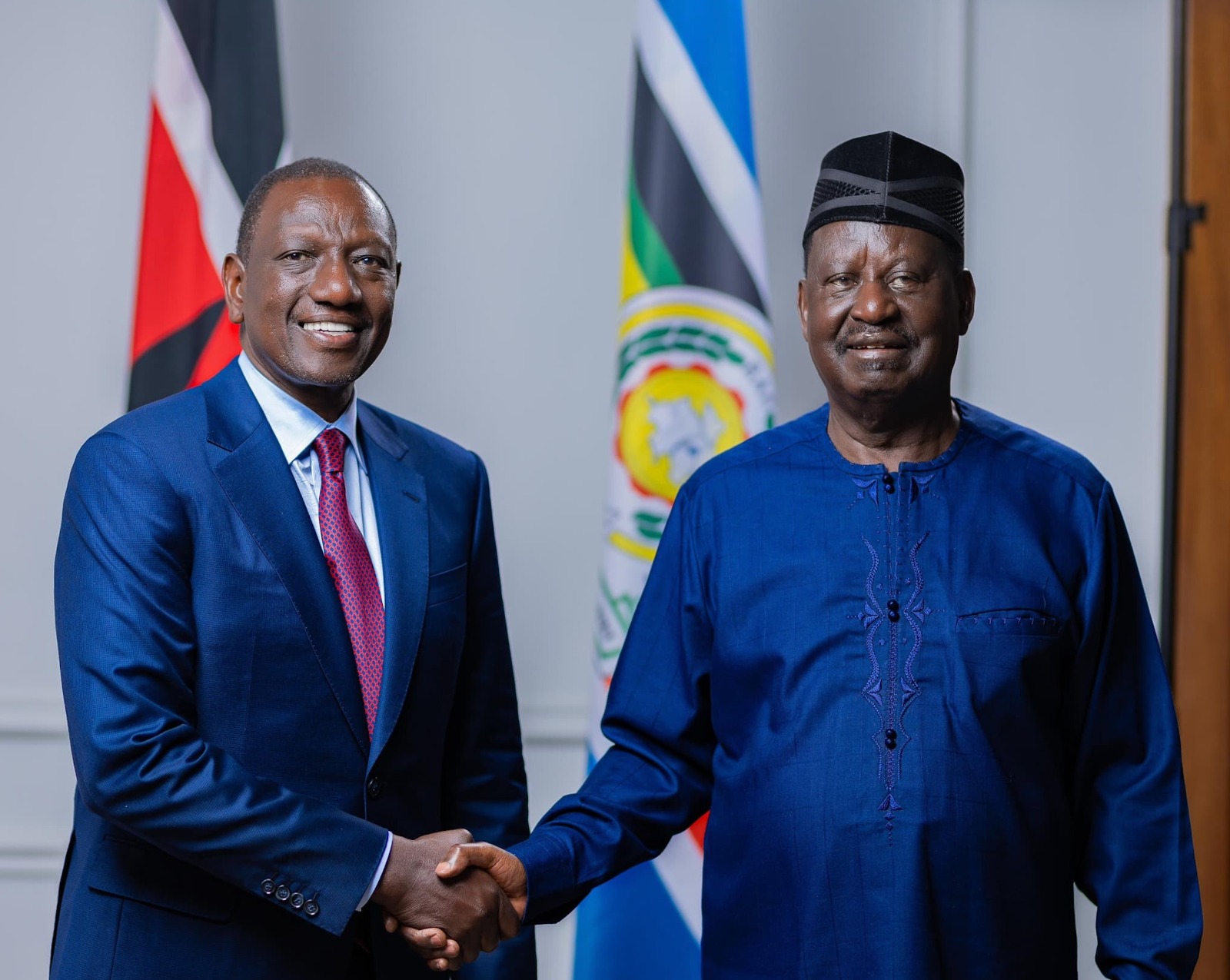
The man who once marched at the frontlines is now seated in high-level boardrooms.
In a twist pregnant with historical irony, Odinga risks being remembered not as Kenya’s liberator-in-chief, but as the country’s most eloquent example of a revolutionary who chose retreat.
The Slow Shift From Firebrand to Fixture.
Raila’s political life has been defined by confrontation — with authoritarianism, electoral injustice, and entrenched inequality.
For many, he was a symbol of unfinished liberation but the 2018 “Handshake “with former President Uhuru Kenyatta altered that image dramatically.
Framed as a peace pact to heal a fractured nation, “the Handshake “ instead sparked widespread disillusionment.
To the political class, it was genius. To the streets, it felt like betrayal.
The Building Bridges Initiative (BBI), its most visible product, was widely criticized as a self-serving power expansion project dressed up as reform.
When Raila lost the 2022 election to William Ruto, many expected him to return to the trenches.
Instead, he began speaking of “inclusive governance” and “dialogue.”
The once familiar language of the streets was replaced with statements that sounded more like policy briefs than protest chants.
The Ghost of Harry Thuku.
Odinga’s quiet pivot finds a haunting parallel in the story of Harry Thuku — one of Kenya’s earliest voices against colonial rule.
In the 1920s, Thuku mobilized mass resistance against imperial injustices, drawing thousands to the cause.
After arrest, exile, and state pressure, Thuku reemerged as a moderate. He chose elite engagement over mass mobilization, and history quietly moved on without him.
Like Thuku, Odinga is now navigating the perilous space between respect and relevance which is still revered but no longer central to the people’s resistance.
The New Resistance Doesn’t Need a Blessing.
Kenya’s current protest movement is spontaneous, decentralized, digitally connected is being led by a generation that has never known a Kenya without Odinga in the headlines.
They don’t chant his name,they don’t wait for his direction and when police bullets fly, he is rarely by their side.
This Gen Z-led wave is raw and unfiltered. It refuses token reforms and rejects token leaders. Their memory is sharp.
Their expectation is unforgiving. To them, Raila’s absence during their hour of need has not gone unnoticed — it has been interpreted.
He is not with them. He is watching.
Between Betrayal and Redemption
But history is not yet sealed. Raila still has the opportunity to choose sides — and to choose them publicly. A symbolic return to the people’s struggle could re-anchor his legacy.
It would require courage: to denounce the politics of convenience, to resist quiet co-option by the Ruto administration, and to align fully with the democratic awakening taking root among Kenya’s youth.
The test is not whether he still has power, but whether he still has purpose.
The memory of Thuku offers a cautionary tale. Respect alone is not legacy. Silence is not neutrality. And in moments of great civic upheaval, absence becomes complicity.
Final Word.
Raila Odinga is at a crossroads — as is the country. Kenya’s new resistance is not waiting for the old guard’s blessing. It is rising with its own voice, its own networks, and its own demands.
History will ask: when the people rose again, where was Raila?
If he chooses silence over solidarity, compromise over clarity, and corridors over crowds, he may discover that what Kenya remembers is not how long you fought — but when you stopped.
Ends.



