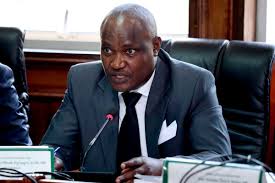
CS for Finance John Mbandi before the Budget Committee last week.
By Peter Mwibanda
NAIROBI, Kenya .
There’s something cruel about the way Kenya talks about education.
We make bold declarations — “free primary education,” “equitable learning,” “CBC is the future.” We cheer presidential speeches and issue glossy policy documents but they in the real Kenya — in the schools with broken desks, unpaid teachers, and no textbooks — the children know better.
This week, President William Ruto reiterated that free primary and secondary education will not be stopped.
His words were emphatic, even hopeful. “It remains the foundation of national development,” he said in Kariobangi. “Every child deserves to learn without barriers.”
Just days earlier, Finance Cabinet Secretary John Mbandi quietly told Parliament what many educationists have feared: the government plans to reduce capitation funding — the financial lifeblood of public schools — in the next fiscal year.
“It is no longer sustainable to fully fund free education at current levels,” Mbandi told the Budget and Appropriations Committee, citing strained public finances.
This contradiction between rhetoric and reality is not new which is dangerous.
Every time a government promises free education and underfunds it, children pay the price — often in silence, and sometimes with their future.
A System at War With Itself
Public schools across Kenya are in survival mode.
Many have not received the promised funding on time, leaving headteachers to make painful decisions: which students to send home, which staff to pay late and which meals to cut.
Meanwhile, parents are forced to contribute “development fees” and buy books — for a system that’s supposed to be free.
Corruption hasn’t helped. Billions earmarked for textbooks, CBC classrooms and digital learning remain unaccounted for.
Some procurement deals read like bad fiction — inflated tenders, ghost deliveries, and unfinished projects passed off as success stories.
Enter Prof. Julius Bitok, the new Principal Secretary for Basic Education, appointed earlier this year to fix what his predecessors, including the ousted Dr. Belio Kipsang, could not.
Bitok has so far struck the right tone: promising quarterly disclosures, internal audits, and procurement reform.
However romises don’t teach children unless they are matched by real disbursements — on time and in full — they remain part of the same political performance we’ve seen for decades.
The Real Cost of Empty Promises
What does it mean when a government says education is free — but cuts its funding?
It means schools delay salaries. It means students are sent home for lunch money. It means CBC collapses under the weight of unfunded mandates.
It means rural schools — already disadvantaged — sink even deeper into poverty.
We must stop pretending that free education is a slogan. It is a serious policy commitment that requires money, integrity, and above all, courage.
Here’s what courage would look like:
Make education funding a constitutional guarantee, immune to political tinkering.
Fully fund basic education to cover meals, desks, electricity, and learning materials.
Fix CBC with teacher training and infrastructure — or stop pretending it’s working.
Reform HELB and rescue our universities before they collapse under debt.
Fund TVET institutions and align them with market-ready skills.
Depoliticize school boards, headteacher transfers, and bursary schemes.
Audit and publish every capitation disbursement, school by school.
Kenya’s education crisis is not about money alone. It is about political priorities. We have the funds — we just choose to spend them elsewhere.
We fund PR campaigns, foreign trips, and luxury cars with ruthless efficiency. But when it comes to a child’s desk, a teacher’s salary, or a school toilet, we suddenly become cautious accountants.
President Ruto is right to say education must remain free until that statement is reflected in the Finance Ministry’s allocations, the Education Ministry’s systems, and the government’s political will, it will remain what it has too often been: a promise betrayed by numbers.
And Kenya’s children deserve better than betrayal.
Ends.