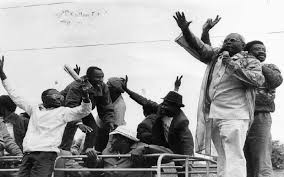
Saba Saba day July 7 1990.
By Peter Mwibanda
NAIROBI, Kenya (IP)
On the eve of the July 7 demonstrations, Kenya stands at a volatile crossroads.
The convergence of Gen Z defiance, millennial disillusionment and an increasingly authoritarian state has set the stage for what many see as the most consequential political reckoning since the return of multiparty democracy.
While July 7 — Saba Saba — has long been revered for the protests that cracked open one-party rule under President Daniel arap Moi, this year’s demonstrations are not about commemorating old struggles.
They are a declaration that the freedoms secured a generation ago are being steadily eroded by a political elite once celebrated as liberators.
“We are confronting a regime that wears the mask of democracy but uses the same tools of repression,” said 24-year-old activist Janet Njeri. “The same men who fought for change are now the ones sending police to crush dissent.”
Many young Kenyans point to the uneasy alliance between President William Ruto and veteran opposition leader Raila Odinga as the ultimate betrayal.
Their handshake — once marketed as a vehicle for national unity — has instead deepened cynicism that politics in Kenya is merely transactional.
The grievances are not abstract. Youth unemployment is estimated to be above 60% in some counties.
The cost of living has spiraled, education remains underfunded, hospitals lack basic supplies, and recent tax proposals have sparked nationwide outrage from a generation that feels economically strangled.
“This isn’t simply about taxes,” said 26-year-old graduate George Omondi. “It’s about a system designed to make us permanent beggars.”
In recent days, the government has ordered schools closed and businesses shuttered, while security forces have fanned out across major cities including Nairobi, Mombasa and Kisumu.
Interior Cabinet Secretary Kipchumba Murkomen has pledged “firm and decisive action” against any disruption — language that echoes the state’s past use of force.
Human rights groups warn that treating unarmed protesters as security threats risks repeating the worst abuses of Kenya’s authoritarian past.
But analysts say today’s system is more refined — and more insidious.
Surveillance technology, digital propaganda, and anti-terror laws are being used not only to deter protest but to control narrative and fracture opposition.
“This government learned from the mistakes of Moi,” said a Nairobi-based political analyst who spoke on condition of anonymity for fear of reprisal.
“Instead of outright bans, they criminalize dissent selectively and keep the rest of the population fatigued and divided.”
Protest organizers claim government operatives have infiltrated their networks, spread disinformation, and harassed digital creators documenting police violence.
Whether Gen Z and millennials can overcome these obstacles remains to be seen. Unlike the 1990 Saba Saba movement, today’s uprising is decentralized, with no formal leadership. That makes it harder to infiltrate — but also harder to sustain.
“It’s one thing to resist the system,” said constitutional lawyer Mercy Mwende.
“It’s another to build an alternative. If this movement doesn’t evolve into something organized and visionary, the system will outlast them.”
Still, the symbolism of this year’s Saba Saba is powerful: a generation declaring that its patience has run out, its future looted, and its voice ignored.
The question now is not whether Kenya’s system is worse than before. It is whether today’s youth are prepared to confront it — and at what cost.
As dusk settled over a tense Nairobi, the country braced for a confrontation that may reshape not only the legacy of Saba Saba, but the future of Kenya’s democracy.
Ends.