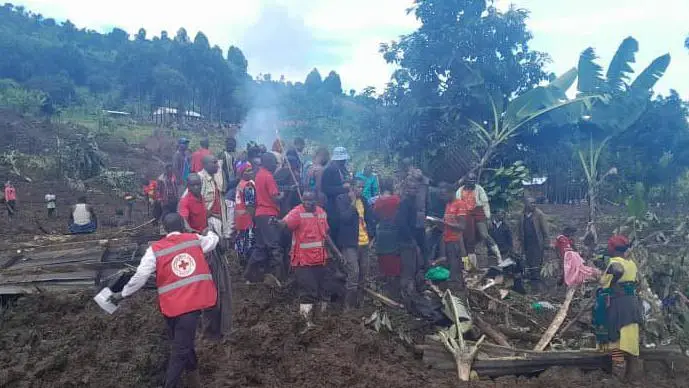
Residents and Uganda Red Cross Workers searching for bodies after the tragedy…Photo/Courtesy.
By I.P. Reporter.
Bulambuli, Uganda.
At least 13 people have been killed in devastating landslides that swept through Bulambuli district, eastern Uganda, following heavy rains on Wednesday night.
The disaster buried 40 homes across six villages, with authorities fearing the death toll could rise to 30.
The Uganda Red Cross Society has so far recovered bodies, but rescue efforts are hampered by blocked roads, persistent rain, and limited equipment.
Covering approximately 50 acres, the landslides have destroyed homes, farmland, and livestock, leaving families devastated.
Heartbreaking scenes show residents digging through thick mud with their bare hands in search of loved ones, while others mourn amid the ruins of their homes.
This tragedy adds to the long list of disasters in the Mount Elgon region, which has repeatedly suffered from landslides triggered by torrential rains.
In 2010, a catastrophic landslide in neighboring Bududa district claimed more than 300 lives, and another in 2018 killed over 40 people.
Despite government relocation efforts, many residents of Bulambuli and surrounding districts have refused to move, citing cultural and ancestral ties to their land.
Resistance is also fueled by delays and inadequacies in compensation and the allocation of alternative land.
Joseph Mauso, a journalist with Eastern Eye, has called on Kenyan leaders to urgently support the victims.
“President William Ruto, as a blood relative of the Sebei people, has a moral and cultural obligation to stand with his kin in Bulambuli during this crisis,” Mauso said.
He also urged the governors of Bungoma, Busia, and Trans Nzoia largely inhabited by the descendants of the Bamasaaba people, who share ties with Uganda’s Bagishu community,to demonstrate solidarity and take immediate action.
Mauso further highlighted the connection of former Busia Governor Sospeter Ojaamong, a Teso by tribe, to the affected region.
“Ojaamong’s relatives have roots in Bulambuli and Soroti. He is uniquely positioned to mobilize resources and support for the victims. This is a time for unity across borders,” he added.
The heavy rains are also causing alarm in Kenya, where Mount Elgon communities in Bungoma, Trans Nzoia, and Busia counties face similar dangers.
Historical data reveals the region’s vulnerability: a 2019 landslide in West Pokot killed 35 people and displaced hundreds, while flooding in subsequent years has destroyed homes, farms, and livelihoods.
Mauso urged Kenyan leaders to heed the lessons of these past disasters and act now.
“President Ruto, as a son of the Sebei, and the governors of Bungoma, Busia, and Trans Nzoia who are Bamasaaba must intervene. Their leadership could save lives and prevent further suffering,” he said.
He also called on families with ancestral connections to Bulambuli to assist their relatives by offering food, shelter, and financial support during this crisis.
The migration history of the Sebei, Bukusu, Teso, and Karamojong peoples from Uganda to Kenya has forged enduring bonds between the two countries.
These shared ties, Mauso argued, demand a unified response to the disaster.
“This is not just Uganda’s tragedy; it is ours too. We must act together, not as separate nations, but as one community bound by heritage and humanity.”
As rescue efforts continue in Bulambuli, the Uganda Red Cross has appealed for more resources to aid survivors.
Immediate assistance, combined with long-term measures such as early warning systems, relocation programs, and infrastructure reinforcement, is urgently needed.
With rains continuing to batter the region, the threat of further landslides and flooding looms large.
Regional governments must prioritize cross-border collaboration to protect the Mount Elgon communities from the growing impact of climate change, ensuring that such tragedies are mitigated in the future.
Ends.