By Peter Mwibanda, Political and Legal Analyst, Intellectuals Post
WASHINGTON/TEHRAN
An abrupt escalation in hostilities between the United States and Israel on one side and the Islamic Republic of Iran on the other has triggered international alarm, disrupted global markets and sparked fears of a widening conflict that could engulf the world.
In a sequence of military strikes launched late Friday, U.S. and Israeli forces targeted strategic positions inside Iran.
Tehran responded within hours with missile and drone attacks on allied bases and infrastructure in the Gulf region.
The result: deaths on both sides, airspace closures affecting thousands of flights, crippling market reactions and a diplomatic firestorm as world capitals grapple with the swift deterioration in regional and global security.
Conflict Erupts, World Reacts
The early stages of the confrontation have already forced stark choices on governments and populations worldwide:
Airspace disruptions:Major carriers across Europe, Asia and the Middle East rerouted flights or grounded aircraft altogether to avoid conflict zones, stranding passengers and complicating international logistics.
Market turmoil:Global stock indexes opened sharply lower as commodity prices climbed, driven in part by concerns over oil supply interruptions from the Gulf region — a nexus for one-third of the world’s crude exports.
Civilian casualties:Hospitals in Tehran and across Iranian urban centers are overwhelmed, and reports from regional media indicate scores of deaths and injuries within hours of the first salvos.
Military mobilizations:Regional allies are reinforcing defensive deployments while diplomatic missions urge de-escalation.
Global Leaders Condemn and Call for Restraint
European leaders, including those of France, Germany and the United Kingdom, publicly condemned Tehran’s retaliatory strikes on Gulf facilities while urging all parties to exercise restraint.
At the United Nations, emergency discussions are underway to prevent further deterioration.
“The prospect of a broader war — with catastrophic humanitarian and economic consequences — is real,” said a senior Western envoy speaking on condition of anonymity.
A Dangerous Gamble
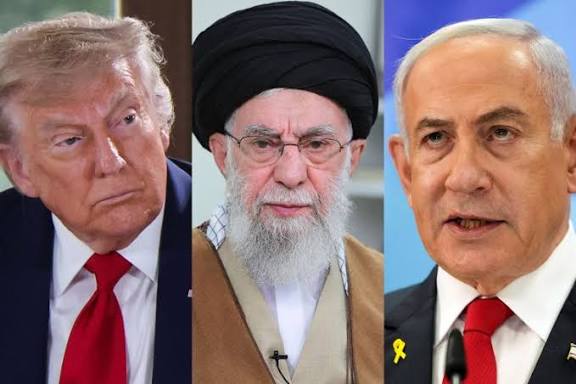
President Donald Trump, addressing the nation, described the strikes as necessary to avert what he called an “existential threat” from Iran’s missile programs and regional proxies.
Israeli Prime Minister Benjamin Netanyahu echoed that assessment, asserting that dismantling Tehran’s offensive capabilities was vital to regional stability.
Critics have accused both leaders of reckless brinkmanship.
“There is a difference between deterrence and escalation,” said Dr. Aisha Rahman, a security studies scholar. “This situation risks undermining long-standing diplomatic balances and international norms.”
International Takeaways
For global audiences tracking the fallout, several key points stand out:
1. A Direct Confrontation Involving Two Nuclear-Aware States
This is a rare instance of direct military engagement involving the United States and Iran — both nuclear-aware actors. The potential for miscalculation or unintended escalation remains high.
2. Economic Shockwaves Will Reverberate Worldwide
Energy markets reacted immediately, with oil prices spiking as traders anticipated potential disruptions in supply from the Gulf. Financial markets also displayed volatility, reflecting heightened risk perceptions.
3. Air Travel and Trade Will Face Disruptions
With several major air routes rerouted or cancelled, passenger and cargo flows are disrupted across continents, affecting travel, trade, and supply chains already strained by recent global challenges.
4. Diplomatic Rifts Deepen at a Critical Moment
European and Asian actors are calling for restraint, but alliances are being tested.
The crisis has already strained relations between Iran and Gulf states, and could fracture multilateral efforts on issues ranging from climate cooperation to nuclear non-proliferation.
5. Public Anxiety Is Now a Global Phenomenon
From North America to East Asia, citizens are watching smoke rise over cities thousands of miles away — a vivid reminder of how localized hostilities can instantly become global in impact.
The Risk of Wider War
Regional powers, including Saudi Arabia and Turkey, are monitoring events closely.
Moscow and Beijing have urged diplomatic solutions while reiterating calls for stability.
Yet, with the initial exchanges already producing fatalities and infrastructure damage, the risk of a wider regional war — and the specter of broader global involvement — cannot be dismissed.
A World Tested
Within hours of the first attacks, the international system — from aviation regulators to financial markets and diplomatic corps — was put to the test.
The crisis underscores a fragile reality: in an era of interconnected security and commerce, conflicts in one region can instantly become global crises.
As this confrontation unfolds, the world watches — fearful that containment will give way to broader hostilities and that this moment, like few others in recent memory, will define the trajectory of international relations for years to come.