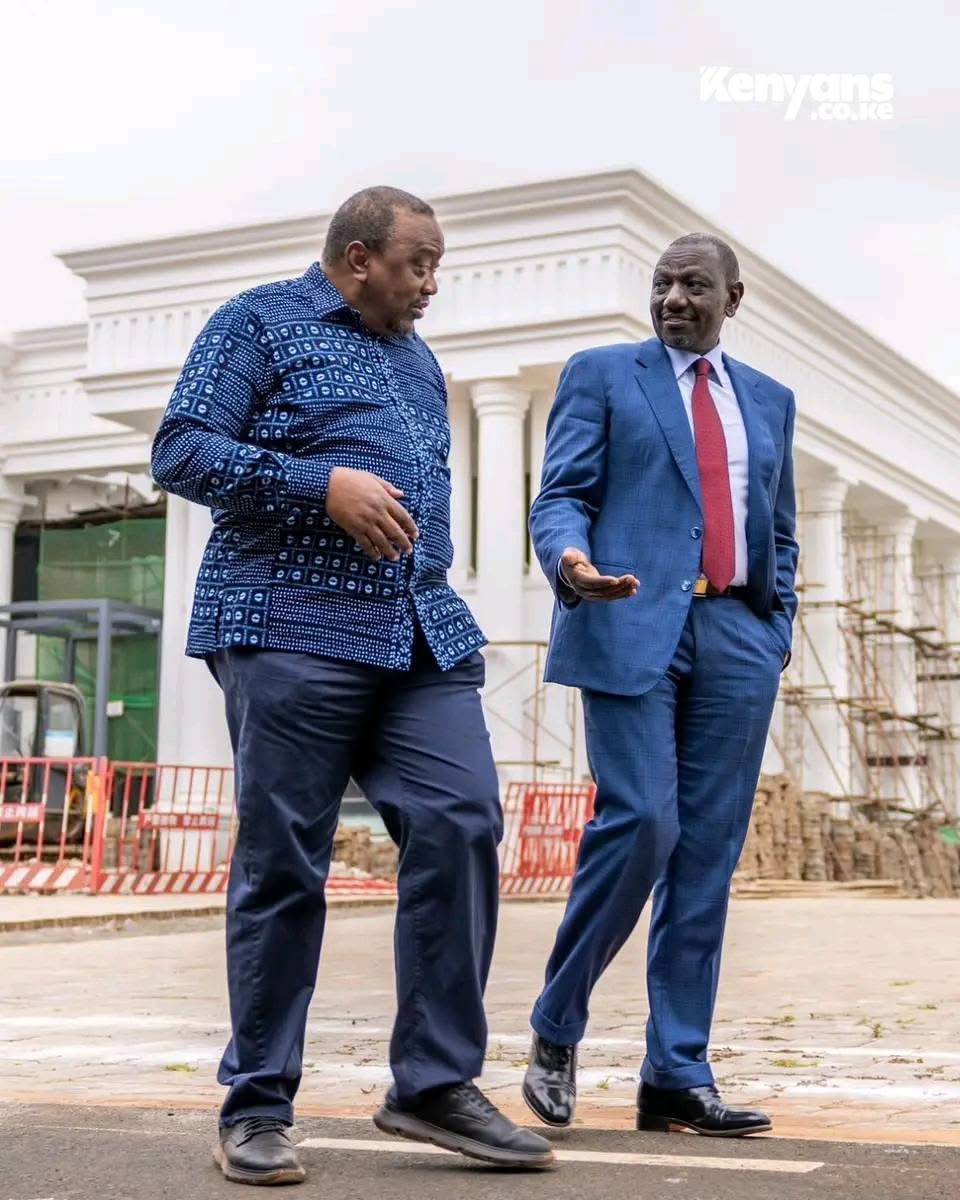
Retired President of Kenya ,Uhuru Kenyatta and the incubent President William Ruto at statehouse last year….Photo /courtesy
By Main Editor.
Kenya’s Constitution is blunt:
after two terms, a president retires. He does not reincarnate as an opposition convenor, regional kingpin, or ideological traffic controller.
Retirement comes with privileges — security, staff, office, vehicles and taxpayer-funded benefits. What it does not come with is permission to play hot-and-cold politics, attacking the government on Monday and quietly coexisting with it by Friday.
Yet Uhuru Kenyatta’s post-presidency has become a masterclass in strategic ambiguity.
“Uhuru Kenyatta has perfected the art of being in opposition and government at the same time,” says Phillip Wanyonyi Wekesa, a political analyst. “That ambiguity may protect his interests, but it suffocates alternative leadership.”
Overshadowing Ruto’s Real Opponents
Perhaps Uhuru’s most consequential political sin is not what he says — but what he blocks.
By inserting himself so forcefully into opposition politics, he overshadows emerging leaders who would otherwise position themselves as genuine successors to William Ruto.
“Every time Uhuru speaks, the opposition conversation stops being about the future and becomes about settling scores with the past,” Wekesa notes. “That robs new leaders of oxygen.”
Instead of a clear post-Ruto alternative, the opposition risks becoming a museum tour — guided by a former president explaining what went wrong during his last years in power.
Hot and Cold Politics: Fighting the Government While Dining With It
Uhuru publicly criticises the Kenya Kwanza administration, points fingers at economic policy, and presents himself as a moral critic of governance. Yet at the same time, his political wing is visibly embedded within the so-called broad-based government.
Cabinet Secretaries associated with Uhuru’s political orbit — including William Kabogo, Lee Kinyanjui and Alice Wahome, among others — sit comfortably in government.
“You cannot convincingly fight a government that is partly staffed by your allies,” Wekesa argues. “That is not opposition; it is negotiated dissent.”
The result is confusion:
Is Uhuru resisting the state — or hedging his bets within it?
Central Kenya: Building an Alternative Power Centre?
Uhuru’s increasing involvement in Mt Kenya politics places him in direct competition with Rigathi Gachagua, the former Deputy President and current DCP party leader, who is attempting to consolidate the region outside State House influence.
This rivalry is not symbolic — it is structural.
“Uhuru is not merely commenting on Mt Kenya politics; he is attempting to reorganise it,” Wekesa says. “That suggests ambition beyond mentorship.”
The question, therefore, becomes unavoidable:
Is Uhuru building an alternative leadership structure in Central Kenya — one answerable to him rather than to the ballot?
Is Uhuru Trying to Replace Raila Odinga?
With Raila Odinga increasingly stepping into continental and elder-statesman roles, a vacuum has emerged within opposition symbolism and ideological leadership.
Into that space steps Uhuru — awkwardly, expensively, and controversially.
“There is a visible attempt to occupy the space Raila Odinga once dominated — moral opposition leadership without direct candidacy,” Wekesa observes.
The ideological alignment of younger politicians such as Edwin Sifuna, Babu Owino and others with figures close to Uhuru has only fueled speculation that the former president seeks to become the new opposition lodestar — without contesting an election.
But history is unkind to unelected opposition generals.
The Ultimate Contradiction
Uhuru Kenyatta today is:
-
Too active to be retired
-
Too protected to be opposition
-
Too influential to be neutral
“You cannot be a referee, team owner and substitute striker at the same time,” Wekesa quips. “At some point, the Constitution demands you pick a role.”
If constitutional amendments reopen political space for former presidents, Uhuru’s proxy projects — including Fred Matiang’i and Kalonzo Musyoka — may quickly become unnecessary intermediaries.
“The moment the rules change, the middlemen will be discarded,” Wekesa says. “Uhuru will run directly to protect his political and business interests.”
Conclusion: A Shadow That Helps the Incumbent
In the end, Uhuru Kenyatta’s activism may achieve the opposite of its stated intent.
By fragmenting opposition leadership, confusing ideological lines, and dominating the political conversation, he clears the field not for change — but for continuity.
“Every election where the opposition is led by yesterday’s president is an election the incumbent enters with an advantage,” Wekesa concludes.
Sometimes, the most effective campaigner for a second term is not the president himself —
but the retired leader who never truly left the stage.