


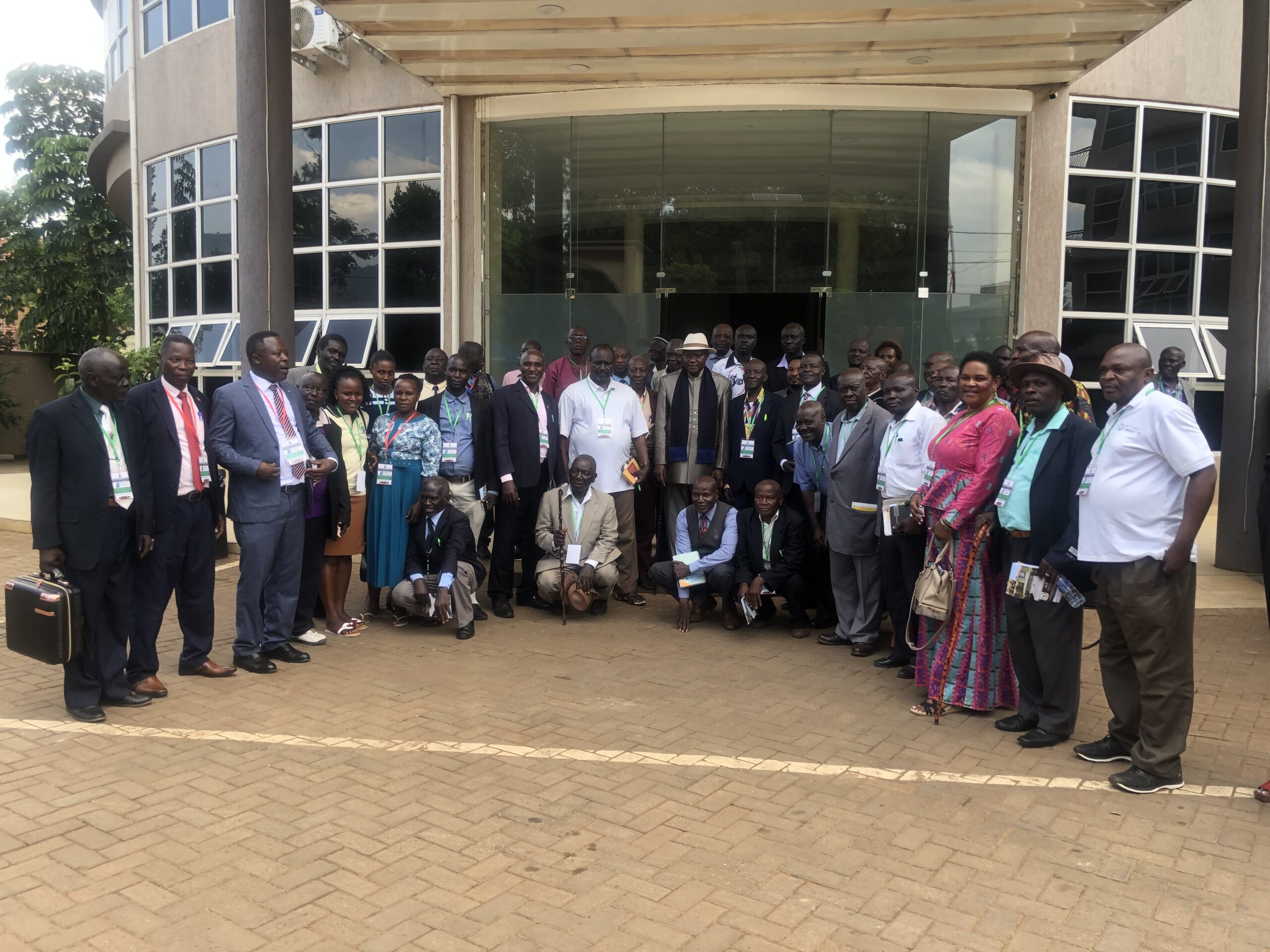
Umukuuka III Jude Mike Mudoma with ministers and clan leaders pose for a group photo after the workshop..,Photo/IP
By IP Reporter
MBALE, Uganda
The Umukuuka III of Bamasaaba his highness Jude Mike Mudoma has announced that beginning next year — the official circumcision year for the community — all initiates will be required to undergo HIV screening and receive clearance from the Ministry of Health before taking part in the cultural rite.
Closing a one-day HIV/AIDS sensitization workshop at a Mbale hotel, the cultural leader said the decision is aimed at protecting young people and ensuring the age-old tradition does not contribute to new infections.
“We are entering a circumcision year. During this period, the ministers and health officials will ensure that every initiate is cleared by the Ministry of Health on their HIV status before circumcision is done,” he said.
He urged families to know their HIV status and promote responsible sexual behavior among their children.
The workshop, sponsored by the Uganda AIDS Commission, ran under the theme “HIV/AIDS Sensitization Workshop for Cultural Leaders.”
Participants were challenged to champion the fight against HIV at the grassroots.
Commitment to End AIDS by 2030
Robert Wandwasi, the Uganda AIDS Commission focal person, called on clan leaders to mainstream HIV awareness in all cultural activities, saying Uganda remains committed to ending AIDS as a public health threat by 2030.
“We should make the Mbale Declaration that we are ending this menace,” he said.
Dr. Stephen Watiti, who serves on the Uganda AIDS Commission board, emphasized the importance of mainstreaming — ensuring HIV is an agenda item in every activity.
He noted that although Uganda targets 95-95-95 by 2025, the country currently stands at 94-90-96.
He reminded leaders that 20,000 people die globally of AIDS-related causes every day, adding that achieving zero new infections and zero stigma by 2030 will require discipline, adherence to medication and community vigilance.
Masiga: ‘We Have Lost the Best Minds’
Steven Masiga, the spokesperson in the Umukuuka’s office, delivered the keynote address, applauding the AIDS Commission for training journalists and urging them to also train clan chairpersons.
“We acknowledge that we have lost the best minds, talents and energetic people in Masaba land due to the AIDS menace,” Masiga said.
He urged clan leaders to educate communities on the dangers of drunkenness and drug abuse, noting that both fuel risky behavior.
With the circumcision period approaching, he said children must be groomed to live responsibly.
Masiga emphasized that the Inzu ya Masaba is committed to supporting the Sustainable Development Goals and building capacity that safeguards future generations.
Clan chairmen, he said, must be sober, objective and willing to move into schools to spread HIV awareness.
‘Circumcision Not the Problem — It’s the Ceremonies’
Dr. Dominic Waburookoh reiterated that HIV prevalence remains highest among young people aged 15 to 40.
He warned that certain cultural practices during and after circumcision ceremonies contribute to risky sexual behavior.
“Circumcision itself is not the problem, but the ceremonies before and after — including the advice we give initiates that they are now mature and should get wives,” he said. “That is where sexual abuse begins.”
He said circumcisers without certification should not be allowed to operate and urged hostels to enforce discipline, saying many youth contract HIV in such unsupervised environments.
Dr. Waburookoh also called for the establishment of an HIV desk at the Inzu ya Masaba to coordinate reporting, data collection and community education.
He warned that 37% of men and 15% of women have multiple partners — a key driver of new infections.
He highlighted that funding for HIV programs comes 14% from government, 80% from development partners and 5.4% from private out-of-pocket spending.
Leaders Raise Alarm on Teenage Pregnancies, Violence
Culture and Heritage Minister Moses Kutoyi warned that AIDS threatens to wipe out future generations if leaders fail to act.
“Gender-based violence is high because of unfaithfulness driven by irresponsible behavior. As elected leaders we cannot be silent,” Kutoyi said.
Minister Irene Mang’ali expressed alarm at rising teenage pregnancies, saying some girls as young as nine are getting pregnant in rural communities.
She called for a return to strict parental guidance.
Simon Peter Nabende Wamoto, the Inzu minister for climate change, posed a provocative question: “Are we worse off with HIV or landslides?”
He said displacement has forced men and women to live separately, pushing many into infidelity. He urged the government to treat resettlement as part of HIV prevention.
Assistant Health Minister Sarah Manana said elders have lamented long enough and must now produce a concrete action plan to guide communities.
Engineer Wekesa, an elder, asked the AIDS Commission to empower young people during school holidays and called for the Umukuuka’s five-year term to become a period of transformation.
A Call for Unified Action
The Umukuuka concluded the workshop by urging clan leaders, government and cultural institutions to stand together.
“If we act collectively, we can save our generation and protect our children,” he said.
Participants agreed to draft community-level resolutions that will guide HIV prevention during the upcoming circumcision season and beyond.



