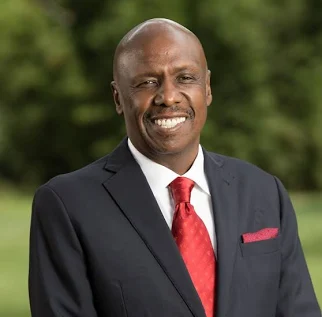
KANU chairman Gideon Moi
By Peter Mwibanda
Political Analyst | Nairobi Bureau
NAIROBI, Kenya (IP)
In a stunning turn that has sent ripples across Kenya’s political landscape, Gideon Moi — son of the late President Daniel arap Moi — has bowed to pressure and stepped down from the Baringo senatorial race.
Moi has ceded ground to a United Democratic Alliance (UDA) candidate aligned with President William Ruto.
The last-minute withdrawal has sparked anger and confusion among his supporters, many of whom gathered in Kabarnet expecting to witness his official nomination submission — only to be left chanting “one term!” in frustration.
Political insiders believe the move signals a quiet but significant realignment and possibly a personal decision by Moi to support or join Ruto’s broad-based government.
Moi has married a coalition that has recently welcomed longtime opposition figure Raila Odinga, despite mounting public dissatisfaction.
The Legacy Dilemma: From Prince to Pawn?
Gideon Moi’s decision raises existential questions about the future of political dynasties in Kenya.
As the scion of Kenya’s second president and former KANU leader, Gideon was once viewed as the natural heir to the Rift Valley’s political throne — a throne now firmly occupied by his father’s former political protégé: William Ruto.
The irony is striking. Ruto, who came up as Moi’s “political son” in the Youth for KANU ’92 movement, has outmaneuvered the dynasty he once served.
The symbolic reversal has not gone unnoticed.
“Ruto’s rise was built on anti-dynasty sentiment. Now, Gideon Moi stepping aside for a UDA candidate is more than a local decision — it’s a surrender of legacy politics,” said Dr. Rebecca Lang’at, a political scientist at Egerton University.
Betrayal or Strategy? Moi’s Silent Gamble
Sources close to Moi indicate the decision was not forced by the ground, where he retains significant traditional support, but by national political calculus.
His absence from the nomination day and refusal to comment publicly suggest a strategic retreat, likely to realign with the ruling coalition quietly.
However, the backlash was swift.
In Baringo and parts of Rift Valley, supporters felt betrayed, having long hoped that Moi’s candidacy would revive regional pride and offer an alternative to UDA’s tightening grip.
Many now view his exit as a capitulation to power rather than a tactical repositioning.
“Gideon left us in the cold,” said Mary Kiptoo, a longtime KANU supporter in Eldama Ravine. “He said he stood for a different kind of leadership. What changed?”
Will This Move Save Ruto’s 2027 Momentum?
The broader question now is: Will Gideon Moi’s quiet alignment help stabilize Ruto’s shaky reelection momentum?
Public discontent remains high, especially among youth and urban voters who have yet to feel any meaningful economic change despite political peace deals and cross-party unity.
President Ruto’s decision to embrace opposition stalwart Raila Odinga in a bid to form a “broad-based” government has not yielded significant policy wins.
Fuel prices remain high, taxation is burdensome and youth unemployment persists.
The Gen Z movement — tribeless, impatient, and digitally organized — is now seen as the greatest threat to Ruto’s second-term ambitions.
Their apathy in the 2022 election turned into vocal discontent in 2024 and by 2025, they are organizing not around personalities but around issues.
“Gen Z doesn’t care about tribal alliances. They want reform, jobs, and a future,” said youth activist Brian Muli. “They will not be swayed by political marriages. They want a political divorce — from the old system altogether.”
Geopolitical Undercurrents and 2027 Realignment
Moi’s step-down may help Ruto consolidate the Rift Valley vote, especially in Baringo, where the president is working to neutralize internal dissent.
Nationally, the move is seen as part of a larger geopolitical chessboard — where former rivals are coalescing not around ideology but survival.
The question remains whether this alliance-building strategy can withstand the storm of economic frustration and generational impatience.
Kenya’s political dichotomy is no longer just dynasties vs. hustlers — it’s status quo vs. system overhaul.
In that battle, neither Gideon Moi nor William Ruto may be safe.
A Quiet Collapse of the Old Order?
As Kenya marches toward 2027, Gideon Moi’s quiet exit may symbolize more than just a personal decision — it could be the death knell for dynasty politics altogether.
Whether Ruto can capitalize on this move remains uncertain.
What is clear is that the youthful electorate — disillusioned, leaderless and unafraid will be the wild card.
Kenya is entering a new political era — and this time, no legacy name, no handshake and no alliance may be enough to stop it.