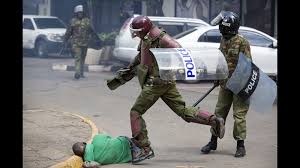
Police brutality during demonstrations in Kenya.
By IP Team.
NAIROBI, Kenya.
When Karioki, a young street vendor known for selling masks in the bustling streets of Nairobi, left his home that morning, he had one goal: earn enough to feed his family.
He was part of Kenya’s informal economy—a web of self-employed youth hustling daily to survive.
Everything changed in a flash. Police officers, in what has become a disturbing trend of unprovoked force, opened fire on a crowd of hawkers. A bullet struck Karioki in the head.
Today, he lies unresponsive in a Nairobi hospital bed, his life hanging in the balance.
“The brain is the command center of the human body,” his attending neurosurgeon said. “Any injury to it—whether from a blunt object or a bullet—alters the person’s ability to think, speak, move or even breathe independently.”
A System Failing Its People.
Karioki’s ordeal is not an isolated case. It represents a growing pattern of police brutality in Kenya, where those charged with protecting citizens are increasingly seen as aggressors.
The Independent Policing Oversight Authority (IPOA), created to investigate such abuses, has been largely silent. In Karioki’s case, no officer has been arrested. No investigation has been publicly confirmed.
This silence has sparked outrage among human rights advocates who say justice has become elusive for the poor and voiceless.
More Than a Medical Condition.
Unlike a broken bone, brain injuries are often invisible but catastrophic. They alter a person’s ability to function and often require lifelong care.
“Even if he survives,” the neurosurgeon said, “he may suffer permanent disability. He may never work again.”
Karioki, once the breadwinner, may now depend on the very people who depended on him. His children could be forced out of school. His family, already struggling, may plunge deeper into poverty.
A Demand for Accountability.
Human rights groups and community leaders are calling for urgent reforms. They are demanding that the officers responsible be identified and prosecuted, and that the IPOA fulfill its constitutional mandate.
Under Article 244 of the Constitution, the police must be professional, respectful of human rights, and subject to the law. Critics say the current force falls far short of those ideals.
Beyond legal justice, there are calls for a wider national conversation about police reform and support for victims—both medically and economically.
A Life Cut Short Too Soon
Karioki’s story is a tragic reminder of the cost of unchecked state violence. He left home to provide, not to become a victim.
His future, once promising, is now uncertain. His children face a life without the stability their father worked for.
As Kenya looks ahead, the country must confront a painful question: How many more lives must be shattered before police brutality is addressed—not just with words, but with action?
Ends.