


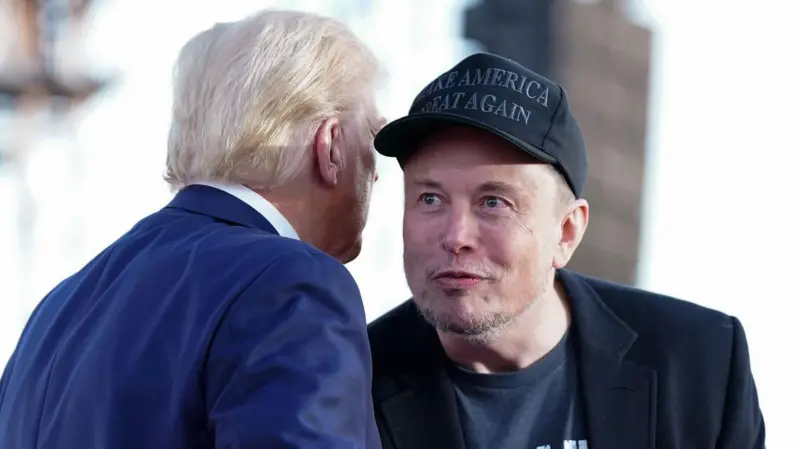
American President elect Donald Trump with Elon Musk.
The U.S. space strategy is at a critical crossroads, and two powerful figures—former President Donald Trump and tech mogul Elon Musk—may play pivotal roles in reshaping the nation’s approach to space exploration, security, and global influence.
As the geopolitical landscape shifts, the intersection of business, politics, and technology in space could determine America’s competitive edge in the 21st century.
Trump’s Vision: Space as a Strategic Frontier.
Under the leadership of Donald Trump, the U.S. space strategy underwent a dramatic transformation.
In December 2019, Trump established the United States Space Force (USSF), a branch of the military dedicated to securing U.S. interests in space.
The move highlighted space as a domain of national security, emphasizing the importance of space-based assets in modern warfare.
Trump’s administration framed space not only as an exploration frontier but also as a vital battleground for global power.
Trump’s “America First” doctrine extended into space, prioritizing the protection of American satellites and infrastructure from growing threats, particularly from China and Russia.
His administration’s commitment to bolstering space capabilities included investments in space defense, the development of a space-based missile defense system, and a broader strategy to counter the rising influence of adversaries in orbit.
Trump’s focus on military readiness in space was accompanied by strong rhetoric about the economic potential of space.
By promoting public-private partnerships and championing companies like SpaceX, Trump set the stage for commercial space ventures to play a critical role in U.S. space strategy.
This convergence of military and commercial interests would continue to evolve as Musk’s SpaceX emerged as a key player in the space race.
Musk’s SpaceX: The Commercial Revolution.
Elon Musk’s SpaceX represents a paradigm shift in the way space exploration is conducted. While the U.S. government, through NASA and the military, has traditionally dominated space endeavors, SpaceX has proven that private companies can push the boundaries of what’s possible in space.
Musk’s vision for space extends far beyond just launching rockets: he envisions a multi-planetary future with humanity settled on Mars. His ambitious goals, combined with SpaceX’s technological innovations, have already had profound effects on the space industry.
SpaceX’s successes, particularly the reusable Falcon rockets and the Starship program, have drastically reduced the cost of access to space.
By competing with traditional aerospace giants like Boeing and Lockheed Martin, Musk has helped reshape the global space market, making it more accessible to a wider range of actors, including private companies and foreign governments.
SpaceX’s dominance in satellite launches, including its ambitious ‘Starlink’ project, further solidifies its position at the forefront of space infrastructure development.
Musk’s push for space commercialization aligns with Trump’s desire to stimulate private sector growth in space.
However, the synergy between the Trump administration’s goals and Musk’s private ventures extends beyond economic growth.
With Musk’s rockets and satellite networks, the U.S. has gained strategic advantages in space-based communications, military surveillance, and intelligence operations—critical elements of national security.
A New Space Race: U.S. Versus China and Russia.
The future of U.S. space strategy will be increasingly defined by its competition with China and Russia.
China’s ambitious space program, spearheaded by its China National Space Administration (CNSA), has seen rapid advancements, including lunar missions, crewed spaceflights, and the development of its own space station, Tiangong.
Meanwhile, Russia continues to be a major player through its state-run ‘Roscosmos’ program, which has extensive expertise in human spaceflight and satellite technology.
As these global powers ramp up their space exploration efforts, the U.S. must balance the interests of its government agencies (such as NASA and the U.S. Space Force) with the rapidly expanding commercial space sector led by Musk’s SpaceX.
This hybrid model—where both public and private sectors collaborate to achieve space supremacy—could enable the U.S. to maintain its technological edge in a rapidly evolving geopolitical environment.
Trump’s advocacy for a more militarized approach to space and Musk’s drive for commercial expansion may not always align perfectly, but they represent complementary forces that can strengthen America’s position in the space race.
If the U.S. can successfully integrate its military, government, and private sectors in space exploration and defense, it will be well-positioned to confront the growing threats from China and Russia, while also reaping the economic benefits of space commercialization.
Trump, Musk, and the Future of Space Strategy.
Looking ahead, the role of Donald Trump and Elon Musk in shaping U.S. space strategy will depend largely on how political leadership, technological innovation, and international competition evolve over the next decade.
If Trump returns to the White House, his vision for space could be more deeply intertwined with national security concerns, potentially driving greater militarization and competition with adversaries.
At the same time, Musk’s growing influence in the commercial space sector could continue to reshape how America interacts with the final frontier.
Whether through building infrastructure for lunar exploration or developing technologies for Mars colonization, Musk’s private ventures are increasingly central to U.S. space ambitions.
For the U.S., space has become more than just a domain for scientific exploration; it is an arena for asserting global leadership, maintaining technological superiority, and ensuring national security.
With Trump’s political clout and Musk’s innovation, the U.S. may well find itself on the cusp of a new era in space, one where the boundaries between government, business, and military interests blur in pursuit of a greater vision for humanity’s future beyond Earth.
Ultimately, the collaboration and competition between these two influential figures—Trump and Musk—could redefine not only U.S. space strategy but also the geopolitical dynamics of the 21st century.
In the grand cosmic chess game, the United States will need to marshal all its resources, from rockets to regulations, to maintain its lead in a universe increasingly shaped by technological power and geopolitical ambition.
Ends.



