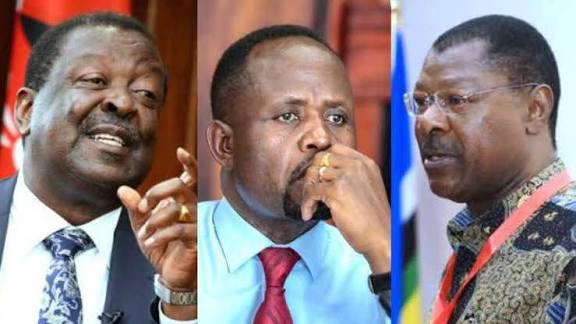
Prime CS Musalia Mudavadi,Trans Nzoia Governor George Natembeya and Speaker of the N.A. Dr Moses Wetang’ula ……Photo/IP
By Peter Mwibanda
Simeon Jirongo’s funeral was more than a commemoration of a political life; it was a live tableau of the Mulembe nation’s awakening political consciousness.
Brilliant, controversial, and consequential, Jirongo’s life embodied the price of politics that confuses access with accountability—a cautionary tale for both leaders and voters as Kenya approaches the 2027 elections.
The Luhya, Kenya’s second-largest ethnic bloc, have long been politically fragmented.
Historically, sub-groups like the Bukusu, Maragoli, Wanga, and Isukha have pursued divergent paths, often diluting the collective influence of the community.
Yet, Jirongo’s funeral revealed subtle signals of consolidation: strategic interactions among leaders, public endorsements, and the careful choreography of alliances hinted at an emerging Mulembe bloc capable of decisive national influence.
Western Kenya, home to over six million registered voters, has repeatedly proven a kingmaker region in Kenyan politics.
Bukusu-dominated Bungoma and Mt. Elgon, Lurambi in Kakamega, and the Wanga strongholds of Mumias are not just local centers; they are potential swing constituencies whose voting patterns could determine presidential outcomes.
Analysts observing Jirongo’s funeral noted the presence of political heavyweights, aspirants, and party strategists—each signaling their intent to negotiate influence over these critical constituencies.
The political lesson is stark: Luhya politics is evolving from personality-driven patronage to outcome-focused strategy.
Communities are increasingly scrutinizing leadership not for access to state resources alone, but for tangible accountability—track records, policy influence, and local development.
The 2027 elections may witness, for the first time, a more unified Mulembe vote capable of bargaining from a position of strength, potentially tipping national coalitions in favor of candidates who can credibly deliver results.
This emerging bloc is not merely a local phenomenon; it carries national implications.
A consolidated Luhya front could redefine Kenya’s traditional Rift Valley–Western Kenya dichotomy, shifting coalition strategies and forcing presidential aspirants to engage more substantively with Western Kenya voters.
Where the Mulembe vote goes, national electoral mathematics will inevitably follow.
Jirongo’s life, in this context, is a microcosm of political caution and opportunity.
It highlights that brilliance alone cannot substitute for accountability, and that leaders who ignore the evolving sophistication of the Mulembe electorate do so at their peril.
For Kenya’s political actors, understanding this awakening is no longer optional—it is central to strategy, negotiation, and survival.
As the country moves toward 2027, the Mulembe nation stands as both a mirror and a magnifier: reflecting the costs of mismanaged politics while amplifying the potential for a decisive, unifying force in Kenya’s democracy.
The coming months will test whether the Luhya vote remains a fragmented echo of past elections or becomes a disciplined, consequential bloc that reshapes the nation’s electoral map.