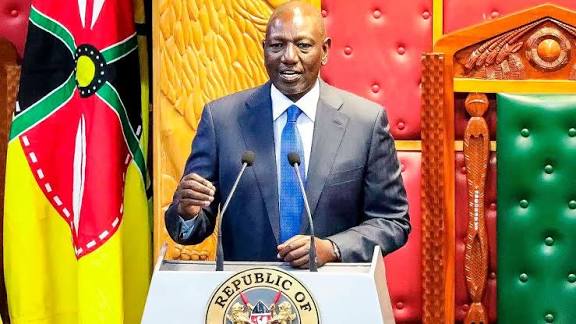
President William Ruto…..Photo /courtesy
By Peter Marango Mwibanda | Opinion | Analysis
President William Ruto’s ambition to transform Kenya into “the Singapore of Africa” is bold, alluring—and dangerously disconnected from the country’s lived reality.
While the comparison evokes images of prosperity, efficiency and order, it collapses under even modest scrutiny, revealing a leadership narrative searching for inspiration abroad while neglecting crises at home.
Singapore is a tightly governed city-state of about 5.9 million people—roughly the size of Nairobi City and its vast daytime population of workers and traders who commute in daily and exit by night.
Kenya, by contrast, is a geographically expansive republic of approximately 56 million people, burdened by regional inequality, historical marginalization and uneven development.
The arithmetic alone makes the comparison misleading.
Kenya cannot be developed like a city. It must be developed like a nation—deliberately, inclusively and equitably, across all its counties.
Corruption as State Practice
Singapore’s rise was anchored on institutional discipline and near-zero tolerance for corruption.
Kenya’s current governance trajectory points in the opposite direction.
Corruption has entrenched itself at the center of state power, normalized as routine governance rather than an aberration.
Individuals close to the presidency have repeatedly been linked to procurement scandals, inflated contracts and alleged looting of public resources.
Anti-corruption rhetoric remains loud, but enforcement is selective, prosecutions sluggish and convictions rare. Public trust continues to erode.
A country cannot dream of Singaporean efficiency while hemorrhaging billions through corruption.
Education in Collapse, Not Reform
Singapore invested heavily in education before it industrialized. Kenya appears to be dismantling its own foundation.
Chronic underfunding, confused reforms and policy experimentation have weakened learning institutions at all levels.
Teachers are demoralized. Universities are under financial strain.
Technical and vocational education—critical for industrial growth—remains neglected.
Without a skilled, innovative workforce, economic transformation is impossible.
Education is not an expense; it is infrastructure. Kenya is treating it as a liability.
Health System Under Strain
The health sector, another pillar of development, is faltering. Public hospitals remain under-resourced, health workers overstretched and industrial action frequent.
Access to quality healthcare continues to depend largely on income and geography.
Universal Health Coverage, once framed as a flagship policy, has drifted into a slogan devoid of lived impact.
A sick population cannot compete in a global economy.
An Economy on Its Knees
Kenya’s economy is under severe strain. The cost of living has surged, driven by high fuel prices, punitive taxation and a weakening shilling.
Wages have stagnated, unemployment—especially among youth—continues to rise, and small businesses are collapsing under regulatory and tax pressure.
Public debt has reached unsustainable levels, consuming a growing share of national revenue.
The country is borrowing heavily not for development, but for debt servicing and recurrent expenditure.
This is not economic transformation; it is fiscal survival.
From Hustler Nation to Singapore Mirage
Notably, President Ruto appears to have abandoned the “Hustler Nation” narrative that propelled him to power.
The promise of bottom-up economic empowerment has quietly given way to elite comparisons and technocratic metaphors drawn from Singapore.
For millions of Kenyans—especially young people—this shift feels like a betrayal.
The hustler language that once spoke to their struggles has been replaced by a distant, elitist vision that offers little relief to those crushed by unemployment and rising costs.
Gen Z and the Politics of Accountability
Kenya’s Gen Z has emerged as a critical force of accountability.
Across protests, digital activism and civic engagement, young Kenyans are rejecting political theatre and demanding substance: jobs, integrity, transparency and inclusion.
This generation is globally aware, data-driven and impatient with recycled narratives.
They are not impressed by foreign comparisons. They are asking hard questions:
Why borrow excessively while services collapse?
Why tax the poor while corruption thrives?
Why speak of Singapore while counties remain underdeveloped?
The Singapore narrative may resonate in elite boardrooms, but it rings hollow in households struggling to afford food, rent and school fees.
Kenya vs. Singapore: A Reality Check
Population:
Singapore: ~5.9 million
Kenya: ~56 million
Governance model:
Singapore: City-state, centralized, technocratic
Kenya: Decentralized republic with 47 counties
Corruption control:
Singapore: Among the world’s least corrupt
Kenya: Consistently ranks poorly on global corruption indices
Education investment:
Singapore: Heavy, sustained, skills-focused
Kenya: Underfunded, fragmented, unstable
Debt profile:
Singapore: Strong fiscal buffers
Kenya: High debt distress risk
The differences are not cosmetic. They are structural.
Vision Without Reform Is Escapism
Kenyans are not asking to be Singapore.
They are asking for working schools, functional hospitals, affordable food, honest leadership and equitable development across the republic.
Singapore did not rise on slogans.
It rose on institutions—strong, credible and trusted institutions.
Kenya’s institutions today are strained, politicized and, in some cases, captured.
Until corruption is confronted decisively, debt is reined in and human development is prioritized nationwide, the Singapore dream will remain a mirage shimmering above a nation struggling to breathe.
Kenya does not need borrowed dreams.
It needs courageous, accountable leadership grounded in the realities of its people.