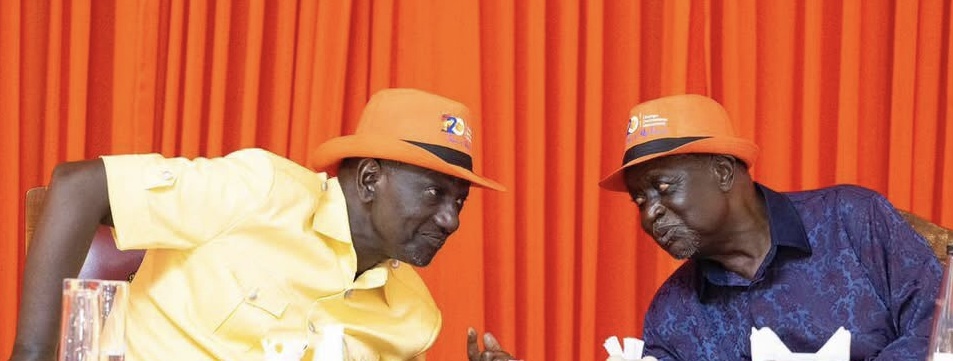
UDA President Dr William Ruto and ODM President Dr Oburu Odinga ….Photo/courtesy
By Peter Mwibanda
IntellectualsPost
17th November 2025
NAIROBI
As Kenya gears up for the 2027 general election, two of the country’s most significant political parties—Orange Democratic Movement (ODM) and United Democratic Alliance (UDA)—find themselves at divergent crossroads.
While both hold key cards in the deck of national politics, they face very different internal and external tests—tests that will determine whether they strengthen or fracture in the run-up to the next historic milestone.
ODM: Legacy, identity and internal fractures
Founded in 2005 and rooted in the “No” vote of the constitutional referendum, ODM has positioned itself as a bastion of democratic reform, social justice and the legacy of its founding leader, the late Raila Odinga.
The party website proclaims its commitment to “Together for Change – Building a Democratic Kenya”.
In recent weeks, however, ODM has exposed deep fault lines.
At the heart lies the question: will ODM remain merely a coalition partner in a “broad-based government,” or reclaim its full identity as a standalone vehicle of power?
Reports show that ODM leaders are clashing over its role within William Ruto’s broad-based government.
Deputy party leadership has emphasised the need for discipline and clarity.
Some voices warn that if the party drifts without direction, the result may be fragmentation.
The legacy of Raila Odinga remains a central rallying point for ODM—even as the party navigates the void his passing creates.
The danger for ODM is two-fold: dilution of brand identity and risk of internal collapse.
The call for party discipline is as much a warning as a vision—if institutional discipline fails, ODM may fragment, with ambitious leaders seeking their own platforms or drifting toward UDA’s orbit.
UDA: Advantage and exposure
As the ruling party under Ruto, UDA enjoys the benefits of incumbency: control of resources, visibility and a campaign machine in motion.
UDA, founded as a formal entity in December 2020, has rapidly risen to prominence.
Incumbency presents its own hazards.
UDA must deliver tangible results and contain internal fissures, while also navigating the optics of sharing space with an historically adversarial ODM inside the broad-based government.
The alliance, though described as not a new political formation, has raised concerns among analysts about the erosion of meaningful opposition.
For UDA, the question is how to maintain its distinct party identity while accommodating ODM’s presence in the government framework.
Failure to do so risks blunting its advantage ahead of 2027, or worse, alienating certain voter blocs who may view the collaboration as opportunistic.
Clash or convergence: The broad-based government and the ten-point agenda
The political pact between Ruto and Odinga—including a ten-point agenda focused on reforms such as devolution, inclusivity, accountability and constitutional change—acts as both structural glue and a pressure cooker for both parties.
For ODM leaders now stressing the need for full implementation of this ten-point agenda, the message is clear: loyalty to the pact is non-negotiable—or risk withdrawal from the framework.
For UDA, the challenge is how to deliver on those reforms without losing momentum or being seen to concede the agenda to the opposition.
Implications for Kenya’s broader political landscape
First, the ODM-UDA dynamic may redefine power-sharing in Kenya.
If ODM proves capable of harnessing its legacy and mobilising disciplined support, it may emerge as the dominant force in the next election.
If it fails, it risks being overshadowed by its coalition partner or fragmenting.
Second, UDA must turn its advantage into results. Otherwise, the governing advantage could become a liability.
Third, the quality of Kenya’s democracy will be tested.
When the main opposition party is effectively in government, the risk of weak oversight and reduced accountability rises.
Some already ask: Does Kenya still have an opposition?
Fourth, for younger voters and women—crucial for both parties—the key will not be rhetoric but performance.
Neither party can afford to assume old bases or tribal loyalties alone will carry them forward.
Conclusion: ODM’s crossroads, UDA’s proving ground
ODM is at a critical juncture: maintain its identity by enforcing discipline and clear leadership succession, or risk implosion.
Its emphasis on Raila’s legacy and adherence to the ten-point agenda reflect a strategy to anchor the party in principle and structure rather than personality alone.
UDA, meanwhile, finds itself in a proving ground: it must turn its advantage into tangible outcomes.
It must show distinct leadership even while featuring ODM in shared governance and ensure its narrative for 2027 is built beyond incumbency.
Kenya’s democracy stands to gain if both parties treat this moment as more than a contest for power—if they offer vision, institutional strength and credible reform.
If not, the turbulence ahead could undermine public trust in parties and politics as usual.