


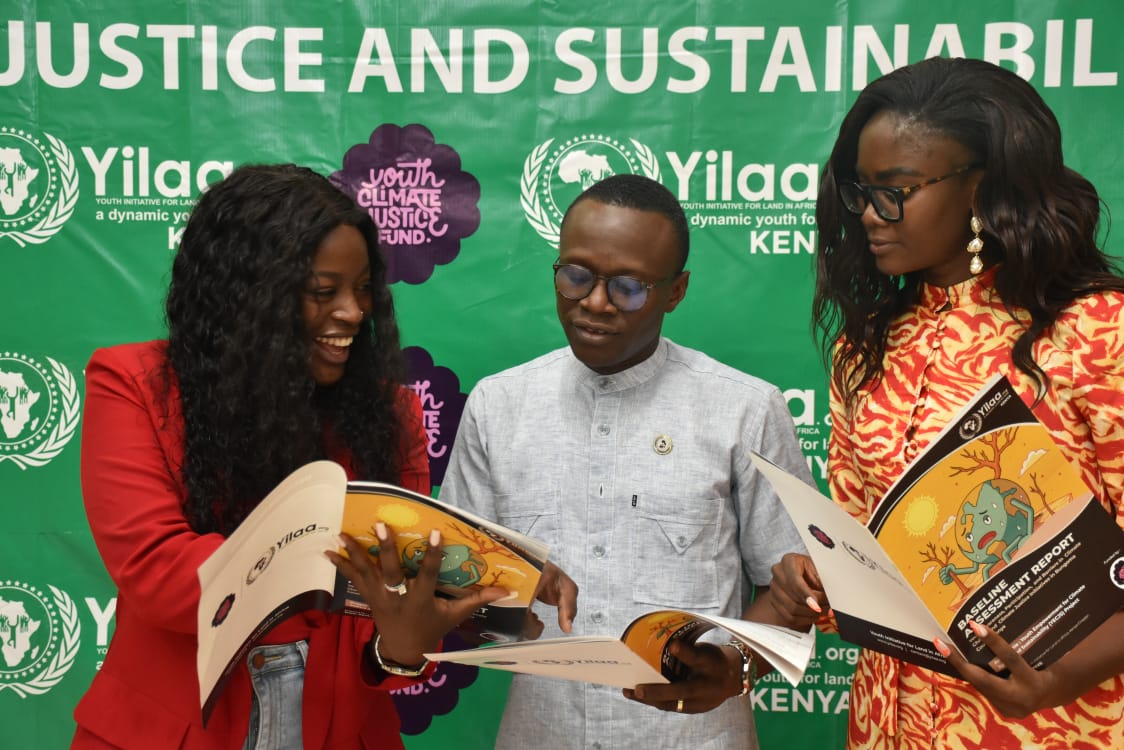
from left – YILAA programme director (kenya) – Julie tsuma, Youth Initiative for Land in Africa – Yilaa Executive Director, Innocent Antoine Houedji (from Benin)-centre and Deborah Oyugi – Volunteer Anglophone Countries Manager at Bungoma Siritamu Hotel during the launch of the program…..Photo/IP
By IP Reporter
BUNGOMA,KENYA
Bungoma County is fast emerging as a frontier for youth-driven climate justice in Kenya, following the launch of the Youth Empowerment for Climate Justice and Sustainability (YECJS) project by the Youth Initiative for Land in Africa (YILAA).
The initiative aims to empower young people to address the twin challenges of climate change and land rights — two issues deeply intertwined with the continent’s environmental and social future.
YILAA Executive Director Innocent Antoine Houedji, from Benin, says the project’s foundation lies in securing land rights for young people — a key step toward sustainable agriculture, biodiversity and climate resilience.
“We are trying to promote and defend the land rights of youth in the continent, which is connected to the question of climate, biodiversity and agriculture,” he said. “We cannot talk about these issues without ensuring land security and inclusion of women in our actions.”
YILAA, which operates in 31 African countries, chose Bungoma as the entry point for its Kenya programme after a baseline study revealed the county’s acute vulnerability to deforestation, flooding and drought.
The study, conducted across Webuye East, Mount Elgon, and Cheptais sub-counties, found that only 27.6 percent of young people had high awareness of climate justice, while nearly half had little or none.
“Bungoma emerged as the county most affected by climate justice issues,” Houedji explained.
“We could not rely only on existing data — we came to confirm what people were reporting. Bungoma needs this kind of project to transform and create value for the community, especially for young people.”
According to the baseline report, most youth-led environmental activities in Bungoma revolve around tree planting and market clean-ups, often timed around national holidays.
However, YILAA’s model pushes for a sustained, community-based approach that goes beyond symbolic actions.
“We are training youth champions in climate justice,” said Houedji. “If we teach 15 young people, each one will go and teach another 15. The awareness spreads widely and helps stop environmental destruction while creating green jobs.”
Through eco-preneurship, YILAA trains youth to transform environmental challenges into business opportunities — such as recycling plastics into jewelry and bags, or turning forest conservation into income through honey production.
“These initiatives create jobs and protect the environment at the same time,” Houedji added.
The baseline assessment, which covered 1,143 respondents aged 18–35, identified financial constraints, limited access to land and lack of inclusion in decision-making as the main barriers to youth participation.
In Cheptais, cultural norms still prevent many young people and women from owning land, while in Mount Elgon, awareness levels and engagement opportunities remain lowest.
For Deborah Oyugi, YILAA’s Volunteer Anglophone Countries Manager, the findings are a wake-up call.
“Only 27 percent of youth are aware of climate justice and resilience, even though Bungoma already has a policy on climate change,” she noted. “It shows we either haven’t done enough to push these initiatives, or we haven’t understood what young people need to grasp them.”
Oyugi says YILAA’s approach focuses on multi-stakeholder advocacy and intergenerational dialogue, emphasizing inclusion and meaningful participation.
“If you’re not included, you’re on the menu,” she said. “Most youth engagements happen at a tokenism level — their views are not integrated into decision-making. We want them at the table.”
Her vision is to shift climate discourse from “boardroom politics” to community ownership.
“At YILAA, we don’t just plant trees — we oversee them grow. We’re making climate change a community issue by amplifying youth voices and promoting alternative livelihoods like kitchen gardens and table banking,” Oyugi added.
At the local level, youth are stepping up as climate champions.
Nanjekho Mulati, from Webuye East’s Youth for Sustainable Development, says her motivation stems from the disproportionate impact of climate change on women and youth.
“We’ve been socialized to carry the burden of climate change. I want to lift it off — for myself, my fellow youth and women,” she said.
Mulati believes Bungoma’s youth must move beyond symbolic acts like planting trees during Mazingira Day.
“We need continuous engagement, not just activities tied to national holidays,” she said.
Her group organizes meetings and fellowships to discuss environmental challenges and inclusion.
“The biggest gap is lack of awareness and exclusion from decision-making,” she added. “Some of us only hear about policies during public meetings.”
For Namusasi Erick Makokha, another youth from Webuye East, YILAA’s training has been transformative.
“I never realized how my own activities were affecting others,” he said. “Now I’ll talk to my community about how flooding, tree cutting and unpredictable weather affect farming — and what we can do together.”
Makokha’s message is one of shared responsibility: “The environment shapes who we are. We must conserve it now for future generations. Nature is green and human beings cannot live without it.”
From Mount Elgon, teacher Timothy Tumwet shared similar reflections.
“Water levels in our rivers have dropped because of deforestation. Floods and landslides are killing people. But all is not lost — people are now planting trees as a personal commitment and that gives me hope,” he said.
Joyce Chepchumba, also from Mount Elgon, highlighted women’s growing involvement in conservation.
“We’ve experienced dangerous landslides recently. If we protect our environment now, we’re saving the future,” she said. “Women can embrace kitchen gardens and biogas use to reduce tree cutting. Traditionally, women couldn’t inherit land, but things are slowly changing.”
YILAA’s baseline report, handed over to the Bungoma County Government, will guide policy reforms and inform the creation of a multi-stakeholder climate platform.
The platform is expected to bring together youth-led organizations, civil society, government departments and development partners to co-create climate action strategies.
The study recommends several strategic measures to strengthen youth engagement in climate action.
First, it suggests the establishment of county-level climate action funds specifically aimed at supporting youth-led initiatives, providing them with the necessary resources to implement sustainable projects.
Second, it emphasizes the integration of climate justice education into school curricula and local radio programs, ensuring that young people and the broader community are well-informed about climate issues and their social impacts.
Third, the study advocates for gender-sensitive land tenure reforms, particularly in areas such as Cheptais, to empower women and young people in climate-resilient land management.
Finally, it proposes the creation of a Bungoma Youth Climate Action Network to coordinate advocacy efforts, facilitate knowledge sharing and strengthen collaborative approaches to climate justice across the county.


Our future is in our hand, our culture will actually safe the issue of climate change