


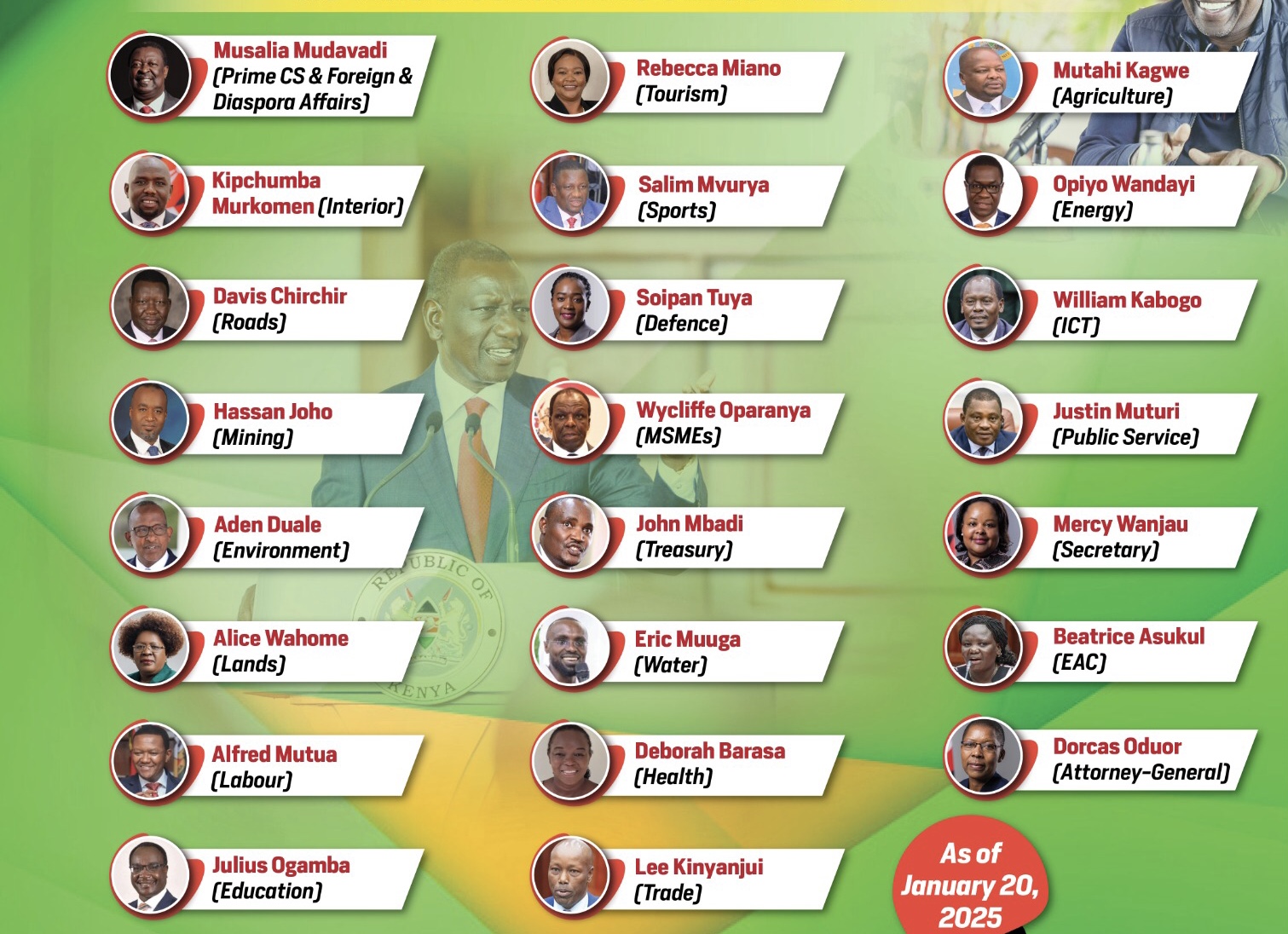
Ruto’s cabinet
By Peter mwibanda
Published on 9/10/2025
Nairobi
What began as a routine investigation into airport security lapses at Jomo Kenyatta International Airport (JKIA) has exploded into a political and security firestorm at the heart of the Kenyan government.
CCTV footage now at the center of an international probe shows a senior aide to a Cabinet minister standing in a queue with an alleged drug trafficker at the airport — a revelation that has cast a harsh spotlight on Kenya’s busiest gateway to the world.
Foreign law enforcement agencies are reported to be closely monitoring the situation.
The scandal, dubbed the “JKIA Cochineal Trail,” has sent shockwaves through the corridors of power and exposed what some security experts are calling a “systemic failure” at one of East Africa’s most critical transport hubs.
The cochineal, a red dye-producing insect, has become the unlikely codename for a complex smuggling network that allegedly uses cargo and passenger routes to funnel narcotics through JKIA.
Sources close to the investigation told IP that the footage — which has not been officially released — was captured by airport surveillance cameras last month.
The video reportedly shows the aide interacting with the alleged trafficker shortly before both passed through an access-controlled area. Authorities have not confirmed whether the meeting was coincidental or coordinated.
The Office of the President has yet to comment publicly on the allegations, though internal security officials are said to be “deeply concerned” by the optics of a government official’s associate being caught in the same frame as a suspect tied to transnational drug trafficking.
Growing International Pressure
Foreign anti-narcotics agencies, including those from the U.S. and Europe, are said to have taken interest in the case, particularly due to recent drug seizures linked to flights originating from Nairobi.
“It’s not just about the drugs anymore,” said a senior aviation security expert, who spoke on condition of anonymity. “This touches on Kenya’s reputation, its aviation credibility, and the possibility that officials may be knowingly or unknowingly aiding smugglers.”
Airlines operating out of JKIA are also facing growing pressure, with some raising concerns over insurance premiums and cargo scrutiny in European and North American markets.
Silence and Scrutiny
At JKIA, a cloud of unease hangs over operations. Employees are reportedly undergoing renewed vetting as part of an internal clean-up ordered by the Kenya Airports Authority. Aviation insiders say the scandal has “seriously rattled” the sector.
Meanwhile, in Nairobi’s political circles, silence is deafening. The Cabinet minister whose aide appears in the footage has not issued a statement, even as calls grow louder for a transparent probe.
Opposition lawmakers have demanded a parliamentary inquiry, while civil society groups have raised questions about the effectiveness of anti-drug enforcement agencies.
“Kenya cannot afford to be seen as a soft target for drug syndicates,” said Wanjiku Ndung’u, an anti-corruption activist. “If our airports are compromised, then our national security is compromised.”
A Smuggler’s Corridor?
For years, security analysts have warned that East Africa’s expanding infrastructure could inadvertently open new corridors for smuggling. JKIA — with its strategic location and high traffic volume — now appears to be a focal point of such fears.
With the scandal gaining traction both locally and internationally, the coming days could prove pivotal for the government, as pressure mounts to act swiftly and decisively.
As the cochineal storm gathers pace, one thing is clear: Kenya’s gateway to the world is under global scrutiny, and the nation’s leadership may soon have to answer difficult questions about who watches the watchers.



