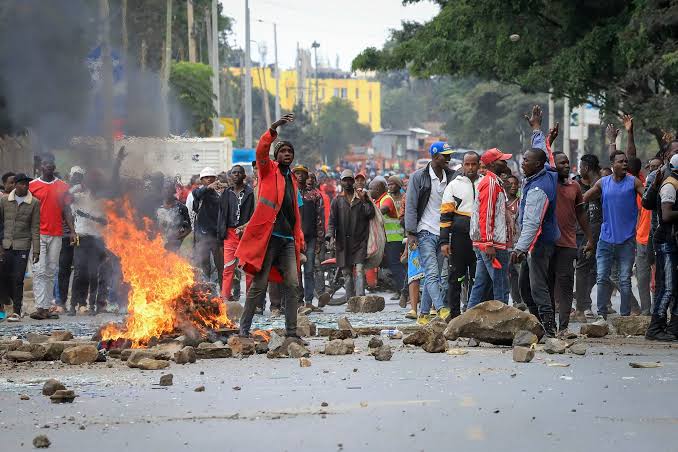
Demonstrations in Nairobi in 2024….Photo/courtesy.
OPINION |
By Peter Mwibanda.
On June 25, 2025, the people of Kenya—led by a courageous and digitally savvy generation—marched into the pages of history.
What began as a spontaneous online mobilization erupted into nationwide protests that shook the government and challenged the political status quo.
These were not ordinary demonstrations. They were a clarion call for justice, dignity and accountability.
The protests must not be dismissed as youthful outrage. They represent a collective outcry against decades of broken promises, economic exploitation and political arrogance.
Unless Kenya listens and responds decisively, this moment may mark either the beginning of deeper unrest—or the start of long-overdue national renewal.
A Generation That Found Its Voice
Often dismissed as disengaged or distracted, Kenya’s Gen Z proved the critics wrong.
They organized with precision, mobilized across social media and turned out in large numbers—peacefully, but powerfully.
From Nairobi to Kisumu, Eldoret to Mombasa, their message was clear: We want a government that listens, serves and delivers.
These young citizens were not mobilized by political parties. They were not driven by tribal interests.
Their loyalty was to the Constitution—and to the dream of a just, inclusive and accountable Kenya. That, in itself, was revolutionary.
The Collapse of the Social Contract
The protests exposed a painful truth: Kenya’s social contract is broken.
Citizens are taxed into poverty while public services crumble. Youth are promised jobs that don’t exist.
Corruption flourishes while whistleblowers are punished. Institutions meant to protect the public now intimidate it.
And when people rise up peacefully to demand justice, the state responds with abductions, bullets and tear gas.
This is not the Kenya envisioned by the 2010 Constitution. What we are witnessing is a betrayal of public trust and the slow death of democratic governance.
Time for National Renewal
The events of June 25 must not be wasted. Kenya is at a pivotal moment, and what comes next will define its future.
The national renewal we need must be grounded in the following principles:
Respect for Constitutional Rights
Peaceful protest (Article 37), freedom of expression (Article 33), and human dignity (Article 28) must be upheld.
State agencies should protect—not persecute—citizens.
End to Extrajudicial Violence
The use of police and covert forces to silence dissent is both illegal and inhumane.
The abductions and deaths linked to the protests must be independently investigated.
Economic Justice for All.
The Finance Bill that sparked these protests reflects deeper issues: economic exclusion and elite impunity.
Public debt must be audited. Corruption must be prosecuted. Resources must serve the people—not a privileged political class.
People-Centered Governance.
Kenyans are tired of top-down decisions. It’s time for bottom-up reforms—anchored in public participation, community-driven development and citizen oversight.
A Moral and Political Reckoning
This is more than a political crisis. It is a moral one.
Leadership in Kenya must stop being about power and start being about purpose. Leaders must stop treating citizens as subjects—and recognize them as sovereigns.
The arrogance displayed in official responses to the protests—the mockery, the denial, the violent crackdown—must be called out for what it is: a betrayal of the republic.
Conclusion: The People Have Spoken
June 25 was not the end. It was the beginning. It was a spark that lit a national flame.
If the government fails to act on the people’s demands, the country risks further unrest, division and erosion of public trust.
But if embraced with humility and vision, these protests could mark the start of Kenya’s rebirth—a new social contract built on justice, equity and accountability.
Kenya is at a crossroads. The people have spoken.
Now the state must decide: Will it repress, or will it reform?
The future of the nation depends on the answer.
Ends.