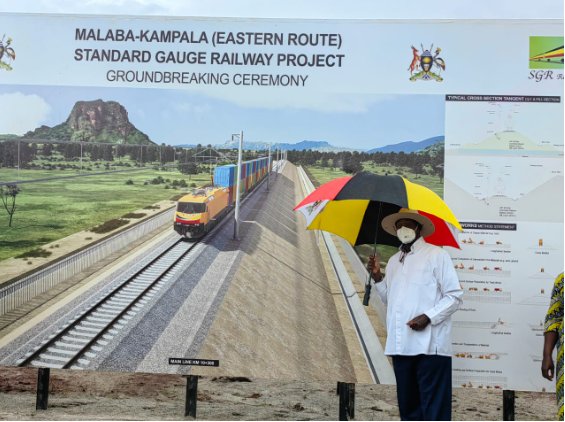
President Yoweri Museveni of Uganda commissions construction of the SGR line at Tororo.
By I.P. Reporter, Uganda
Uganda has officially launched the Tororo-Kampala Standard Gauge Railway (SGR) project, a key initiative aimed at boosting regional trade and connectivity.
The $3 billion project, developed in partnership with Turkey’s Yapı Merkezi, will involve constructing a 272-kilometer railway linking Kampala to Malaba on the Kenyan border.
This will establish a vital link to Kenya’s port of Mombasa, facilitating smoother trade flows across the region.
President Yoweri Museveni has stressed the importance of completing the project within the planned timeline.
He affirmed the government’s commitment to ensuring the SGR is built to high-quality standards and delivered on schedule.
Construction is set to begin in November 2024, with an estimated completion time of 48 months.
The project will be financed through a combination of domestic resources and credit from export finance organizations.
Officials are optimistic about meeting deadlines and maintaining quality throughout the construction phase.
The project is part of a broader strategy to create a 1,700-kilometer electric railway system across Uganda.
This modernized infrastructure is expected to transform the country’s transport sector, cutting transport costs and enhancing the movement of goods, particularly to regional ports such as Mombasa.
The new railway is expected to boost Uganda’s trade potential and contribute significantly to long-term economic growth.
Once completed, the Tororo-Kampala SGR will drastically shorten cargo movement times compared to the old narrow-gauge railway line.
The new SGR will allow cargo trains to travel at speeds of up to 100 km/h, compared to the slower speeds of the existing system, which averages around 30-50 km/h.
This increase in speed will enable goods to be transported more quickly across Uganda, reducing transit times.
Additionally, the SGR’s larger capacity, with the ability to handle up to 25 million tons of cargo annually, will allow for a more efficient flow of goods, easing congestion on both roads and railways.
With improved infrastructure, the SGR will also offer more reliable service, reducing delays and ensuring faster, more predictable delivery times.
The direct link to Kenya’s Mombasa port will further streamline cargo movement, reducing the need for multiple handling and transfer points that slow down the current system.
As a result, goods will move more efficiently from Uganda to the coast, cutting transport costs and boosting trade.
Regional Impact and Kenya’s Role
Once completed, the SGR will improve trade by lowering transportation costs between Uganda and Kenya.
This will complement Kenya’s existing SGR line, which connects Mombasa to Naivasha.
However, Kenya has yet to begin construction of the Naivasha-Malaba stretch, due to financial constraints and logistical challenges.
While Kenya completed the Mombasa-Naivasha section in 2019, the extension to Uganda remains stalled, raising concerns about regional trade integration.
Tanzania has outpaced both Uganda and Kenya in SGR development.
The country has made significant strides with its 1,219-kilometer SGR line from Dar es Salaam, connecting to several landlocked regions.
Led by Yapı Merkezi, Tanzania’s project is expected to reduce transport costs by more than 40%, improving efficiency and making Tanzanian exports more competitive.
The Tanzanian government has secured a variety of international investments, including funding from China and Turkey, allowing the project to advance smoothly.
Tanzania’s success is attributed to strong government backing and proactive efforts in securing land and financing.
In contrast, Kenya and Uganda have faced delays due to funding challenges and the complexity of integrating their respective rail networks.
Promoting Local Participation
Uganda’s SGR project will also involve local businesses, with plans to source construction materials from companies such as Roofings and Hima Cement.
This approach aligns with the government’s goal of involving local stakeholders in national development, supporting economic growth within Uganda.
The Tororo-Kampala SGR project is poised to revolutionize Uganda’s transport infrastructure, reducing congestion on roads and fostering regional trade.
The new railway will significantly shorten cargo movement times, boost trade, and improve overall efficiency.
However, competition between the rail networks of Kenya, Uganda, and Tanzania remains strong, with Tanzania’s early progress setting a high bar.
As Uganda’s project moves forward, Kenya will need to address its delays and financial challenges to complete its own SGR expansion, maintaining its place in the growing East African transport network.
Ends.